Using RPE to pace your intervals
Learn how to use the Rating of Perceived Exertion scale to pace high-intensity intervals, pair it with heart rate data, and optimize your rest periods.
By The HIT Method Training Desk 06:00 read
Relying only on a heart rate monitor during high-intensity intervals can sometimes lead to frustration. Heart rate monitors have an inherent delay. When you start a hard sprint, your cardiovascular system takes time to catch up to the mechanical work your legs or arms are doing. By the time the screen shows your target heart rate zone, the interval might be almost over. This delay is known as cardiac lag, and it makes pacing short intervals solely by heart rate difficult.
This is where the Rating of Perceived Exertion scale becomes a highly useful tool. Often called RPE, this scale relies on your physical sensations to guide your training intensity. By reading your breathing, muscle fatigue, and ability to speak, you can pace your intervals accurately from the first second. A one to ten scale allows you to adjust your effort based on daily fatigue, stress, or poor sleep.
The one to ten effort scale explained
To use perceived effort effectively, you must understand what each number on the scale feels like. The scale is subjective, but anchored by real physical responses in your body, primarily your breathing rate and your ability to talk.
RPE 1 to 3 represents light activity. You can breathe easily through your nose and hold a continuous conversation. Your muscles feel loose, with no burning sensation. This is the effort of a slow walk or a gentle warm-up.
RPE 4 to 5 is a moderate effort. Your breathing deepens, and you might start to sweat. You can hold a conversation, needing a breath every few sentences. This feels like a brisk walk or a steady jog.
RPE 6 to 7 marks the transition into vigorous effort. Your breathing is heavy and rapid. You can no longer hold a conversation easily. You can speak in short sentences, but you would rather not talk. You feel a mild burn in your working muscles.
RPE 8 is a very hard effort. You are breathing forcefully through your mouth. Talking is restricted to single words. The effort feels highly uncomfortable, and you actively want to rest. Most people can hold an RPE 8 for a minute or two at most.
RPE 9 is an extremely hard effort. Your lungs are working near maximum capacity. You cannot speak at all. Your muscles burn heavily, and maintaining technique requires intense focus. You can hold this level only briefly.
RPE 10 is an absolute maximum effort. This is an all-out sprint giving everything you have. You can hold it for only a few seconds. If you try to hold an RPE 10 longer, your form will inevitably break down.
How to pair perceived effort with heart rate
Using perceived exertion does not mean discarding your heart rate strap. The two metrics work best together. Perceived effort gives immediate feedback, while heart rate provides objective data about your cardiovascular response and recovery between intervals.
When you start a high-intensity work interval, aim for your target RPE immediately. Do not wait for your heart rate to climb. If the workout calls for an RPE 8, push hard from the first second until your breathing and muscles tell you that you have reached that effort. Your heart rate will gradually rise to reflect that effort by the end of the interval.
Environmental factors make this combination valuable. Heat, high humidity, dehydration, or poor sleep can elevate your heart rate. If you strictly follow a heart rate target on a hot day, you might work at an RPE 9 just to hit a zone that usually feels like an RPE 7. Trusting perceived effort helps manage fatigue and prevents overexertion. Conversely, certain medications artificially lower your heart rate. For people taking these, perceived exertion is the most reliable way to gauge high-intensity intervals.
During the recovery interval, heart rate becomes highly useful. You can watch your heart rate drop to confirm that your cardiovascular system is recovering. Rest until your breathing calms down to an RPE 3 and your heart rate settles into a moderate zone. Over time, comparing perceived effort to heart rate data helps calibrate your internal gauge.
Using RPE to pace work and recovery intervals
Applying the exertion scale requires practice. Beginners often start too fast, hitting an RPE 9 or 10 in the first interval. This early exhaustion compromises the rest of the workout, forcing you to cut the session short or perform remaining intervals at a lower intensity. The goal is to reach the prescribed effort level and hold it steady.
For work intervals lasting thirty to sixty seconds, an RPE of 8 is generally appropriate. You should feel a significant burn and heavy breathing, but you should not feel completely exhausted until the final few seconds. If the work interval is shorter, such as fifteen to twenty seconds, you can safely push into RPE 9 territory.
Recovery intervals are equally vital. Active recovery should fall between RPE 2 and 3. This means moving slowly on a stationary bike or walking slowly on a treadmill. The objective is to allow your muscles to recover without adding cardiovascular stress. If your breathing has not returned to a conversational level by the end of the rest period, extend your recovery time.
A practical interval workout using perceived effort
To practice this pacing strategy, here is a structured workout. Perform this on a stationary bike, a rowing machine, an elliptical, or a clear running track.
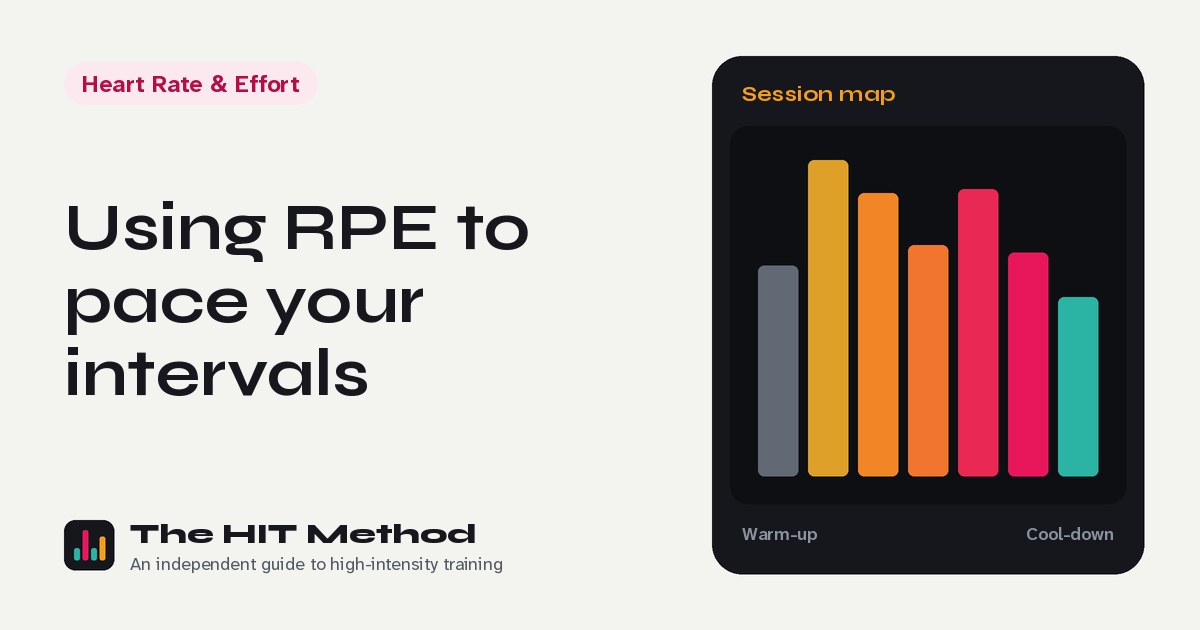
Begin with a warm-up. Spend five to eight minutes slowly increasing your effort. Start at an RPE 2 and gradually build to an RPE 5. Include two or three short bursts of ten seconds at an RPE 6 to prime your muscles.
The main workout consists of six rounds of work and recovery:
- Round one: Thirty seconds at RPE 7, followed by sixty seconds of active recovery at RPE 2.
- Round two: Thirty seconds at RPE 8, followed by sixty seconds of active recovery at RPE 2.
- Rounds three, four, and five: Thirty seconds at RPE 8 to 9, followed by sixty seconds of active recovery at RPE 2.
- Round six: Thirty seconds at RPE 9, followed by sixty seconds of active recovery at RPE 2.
Pay close attention to your technique. When pushing toward an RPE 9, it is easy to let your form deteriorate. Keep your core tight, maintain good posture, and focus on smooth movements. If you cannot maintain the target effort for thirty seconds without losing form, scale the workout back by extending the recovery time to ninety seconds or stopping at four rounds.
Finish with a cool-down. Spend at least five minutes moving gently at an RPE 2. This allows your breathing to normalize and your heart rate to return to a resting state.
Adjusting for safety and individual conditions
High-intensity training places significant stress on the body. It is completely acceptable to modify effort targets based on your fitness level and health status. Beginners should cap their maximum effort at an RPE 7 for the first few weeks of interval training. This allows joints, muscles, and the cardiovascular system to adapt without excessive risk of injury.
People who are pregnant, postpartum, or returning from illness or injury must exercise extra caution. Focus on moderate intervals and avoid pushing into the very hard RPE 8 or 9 zones entirely, unless cleared by a medical professional. Your body requires energy to heal, and pushing to near-maximum effort can hinder that process.
Individuals with a history of joint problems should be careful about the equipment they choose. Avoid high-impact activities like sprinting on pavement. Instead, choose low-impact equipment, such as a stationary bike, a rowing machine, or a swimming pool. These options allow you to achieve a high cardiovascular effort without placing destructive stress on vulnerable joints.
When to stop and see a doctor
High-intensity intervals are physically demanding. Stop your workout immediately and seek medical advice if you experience chest pain, pressure, or tightness. Fainting, near-fainting, dizziness, or severe lightheadedness are clear warning signs that require a doctor’s evaluation.
Halt your session if you notice unusual breathlessness that does not improve during a recovery interval, or if you feel irregular heart palpitations. Anyone with known heart conditions, lung disease, metabolic conditions like diabetes, or high blood pressure must consult a physician before starting high-intensity training. Always seek medical guidance if you experience joint or muscle pain that persists or worsens during exercise, or if you are pregnant or recovering from a recent illness or injury.