A 20-minute bodyweight HIIT workout with low-impact swaps
Complete a challenging 20-minute high-intensity interval session at home without equipment. Includes a warm-up, clear intervals, and no-jumping options.
By The HIT Method Training Desk 06:00 read
You have a small window of time and limited floor space. Finding room for a productive workout at home usually means relying on bodyweight movements. High-intensity interval training fits well into this scenario, but the standard exercises often involve heavy impacts that bother joints or disturb neighbors.
You can build a challenging session without a single jump. The structure provided here delivers a complete 20-minute workout that scales to your current fitness level. Every movement includes a primary high-impact version and a low-impact alternative.
Both options demand effort. Removing the jump does not mean removing the intensity. You can still drive your heart rate up by moving faster, sinking deeper into the positions, and minimizing transition time between repetitions.
The 20-minute workout structure
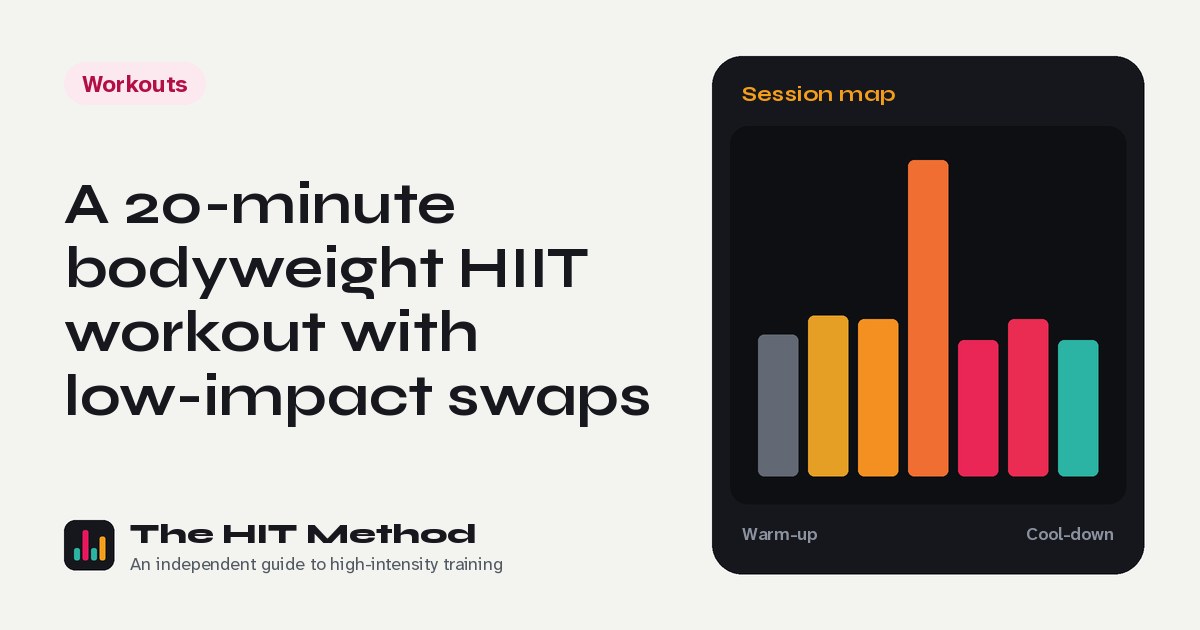
This session is divided into three parts: a five-minute warm-up, a 12-minute main work block, and a three-minute cool-down. The main block uses a strict time-based interval approach. You will work for 40 seconds and rest for 20 seconds.
During the 40 seconds of work, the goal is to reach a high level of exertion. On a scale of one to ten, aim for a Rate of Perceived Exertion of eight or nine. You should be breathing heavily and struggling to speak in full sentences.
During the 20 seconds of rest, focus entirely on recovering your breath. Stand up, walk around slowly, and prepare for the next round. Active recovery keeps your blood flowing and helps maintain venous return to your heart.
You will alternate through four exercises. Completing all four exercises counts as one round. You will perform three total rounds to complete the 12-minute block. Keep a timer visible so you know exactly when to work and when to rest.
The warm-up sequence
A thorough warm-up prepares your muscles and cardiovascular system for the sudden demands of high-intensity intervals. Spend five minutes moving continuously at a low intensity to elevate your body temperature.
Start with one minute of easy marching in place. Lift your knees high and swing your arms naturally.
Move into one minute of arm circles. Make small forward circles for 30 seconds, then reverse the direction and gradually increase the size of the circles.
Follow this with one minute of torso twists. Stand with your feet shoulder-width apart, keep your hips facing forward, and gently rotate your upper body from side to side.
Next, perform one minute of shallow bodyweight squats. Keep your chest up and lower your hips halfway down to prepare your leg muscles without pushing to failure.
Finish with one minute of alternating forward lunges. Step forward, lower your back knee slightly toward the floor, and push back to the starting position.
The main interval block
Perform these four movements in order. Choose the primary exercise or the low-impact alternative based on your joints and your environment.
Exercise one: Squat jumps
Stand with your feet slightly wider than shoulder-width. Push your hips back and bend your knees to lower into a squat. Keep your chest lifted. Keep your eyes looking forward to maintain a neutral spine. Drive upward explosively so your feet leave the ground. Swing your arms down for momentum. Land softly with bent knees to absorb the impact and lower into the next repetition. Do not let your knees collapse inward as you push off the floor.
Low-impact swap: Bodyweight squats with a heel raise. Lower into the deep squat. As you stand up, drive through your feet and rise onto your toes. Reach your arms overhead. Squeeze your glutes at the top, lower your heels, and descend directly into the next squat.
Exercise two: Mountain climbers
Start in a high plank position with your hands under your shoulders. Keep your back flat and your core tight. Quickly drive your right knee toward your chest, then immediately switch legs, driving the left knee forward as the right leg returns back. Keep your hips still while your legs move at a running pace. Keep your shoulders actively pressing away from the floor to avoid sagging in your upper back. This stability protects your shoulder joints.
Low-impact swap: Slow marching planks. Hold the high plank position. Slowly bring your right knee to your right elbow. Pause for a brief second, then return the foot to the floor. Repeat on the left side. Focus on a tight core and controlled breathing.
Exercise three: Skater hops
Stand on your right leg. Leap sideways to the left, landing softly on your left foot. Let your right leg sweep behind your left leg and swing your arms naturally. Immediately push off the left foot to leap back to the right side. This lateral movement builds side-to-side power and stability. Use your core to stop your lateral momentum sharply before exploding back in the other direction.
Low-impact swap: Lateral step with a deep curtsy. Take a wide, deliberate step to the left. Sweep your right foot behind your left leg and bend both knees into a deep curtsy lunge. Push through your left heel to stand up, then step widely to the right and repeat.
Exercise four: Burpees
Stand tall. Drop your hands to the floor just in front of your feet. Jump both feet back simultaneously to land in a high plank position. Jump both feet back toward your hands, stand up, and perform a small vertical jump at the top while reaching your hands toward the ceiling. Inhale as you lower yourself, and exhale as you exert force to jump back up.
Low-impact swap: Walkout to plank and stand. Bend at the waist and place your hands on the floor. Step your right foot back, then your left foot back, ending in a stable high plank. Step your right foot forward, then your left foot forward, and stand up tall without jumping.
The cool-down
Your heart rate will be highly elevated at the end of the final interval. Do not sit down immediately. Stopping abruptly can cause dizziness. Spend three minutes bringing your system back to baseline.
Walk slowly around your room for one full minute. Take deep breaths in through your nose and out through your mouth to deliberately slow your breathing rate.
Spend the next two minutes performing static stretches. Reach for your toes to stretch your hamstrings, holding the position for 30 seconds.
Next, use a wall for balance and pull one heel toward your glutes to stretch your quadriceps. Hold this position for 30 seconds per leg.
How to scale and progress the routine
High-intensity training must match your current capabilities. If the 40 seconds of work feels too demanding, or if you lose your technique early in the interval, modify the work and rest periods.
- Beginner option: Work for 20 seconds and rest for 40 seconds.
- Intermediate option: Work for 30 seconds and rest for 30 seconds.
- Advanced option: Work for 45 seconds and rest for 15 seconds.
You can also mix and match the movements across different rounds. If your knees tolerate skater hops but not burpees, use the primary version for the hops and the low-impact walkout for the burpees.
To progress the workout over time, you can increase the work interval duration, decrease the rest interval duration, or add a fourth round to the main block. Make only one change at a time. Perform this style of workout on two or three non-consecutive days per week, allowing for adequate rest in between sessions.
When to stop and see a doctor
High-intensity workouts place significant stress on your cardiovascular system and muscles. Stop training immediately and seek medical attention if you experience chest pain, pressure in your chest, unusual breathlessness, palpitations, dizziness, fainting, or near-fainting.
Consult a doctor before starting this or any high-intensity routine if you have a known heart condition, lung disease, metabolic disorders like diabetes, or high blood pressure. You should also get medical clearance if you are pregnant, postpartum, or returning from a recent illness or injury. Do not push through joint pain or muscle pain that persists or worsens during movement. Modifying exercises is helpful, but it does not replace professional medical advice.